The senior partner’s room at Sterling, Vance & Butterworth in Lincoln’s Inn Fields felt like a cathedral of old vellum, beeswax, and centuries-old silence.
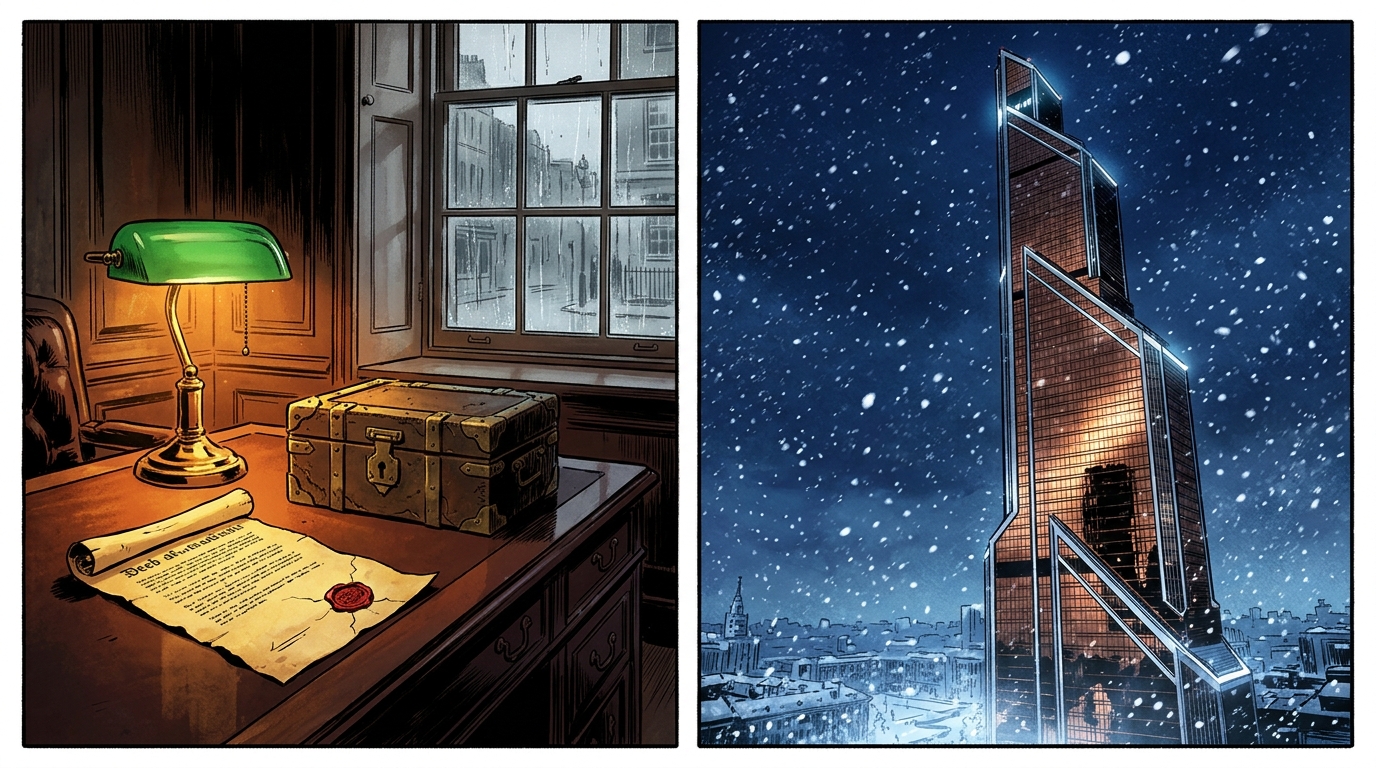
On a rainy morning in August 2018, twenty-year-old Nestor Ioannou Drakos sat in a buttoned leather armchair across from Mr Arthur Sterling—a solicitor who looked as though he had been preserved in dry sherry and Chancery precedent—watching the old man break the heavy crimson seals on an iron deed-box.
Until forty-eight hours earlier, Nestor had not set foot in London since the night of the second of September 1666. Walking from Holborn station past the leafy railings of Red Lion Square that morning, he had stood for ten minutes on the pavement at the corner of Dane Street, staring at the brick Georgian facade that had replaced the timber shop of the Brownes and the workshop of John Harrison. His pulse was still hammering in his ears.
‘The terms of the codicil were unusually explicit, Mr Drakos,’ Mr Sterling said, his voice a dry papery rustle as he lifted a flat package wrapped in oiled silk from the deed-box and slid it across the mahogany desk. ‘This trust was established in the spring of 1776 by a private benefactor who deposited a substantial sum in East India stock and gold bullion with our founding partner. For two hundred and forty-two years the capital has been reinvested under strict discretionary mandate, awaiting a claimant who would present himself in August 2018 bearing both the name Nestor Ioannou Drakos and the mechanical key you produced in our outer office.’
Nestor’s hand rested on the gold H6 lying upon the green leather blotter between them. With his other hand, he untied the silk ribbon and opened the inner envelope. Inside lay a single sheet of heavy eighteenth-century rag paper, yellowed at the edges and smelling faintly of coal-smoke.
When Nestor looked at the ink script, the breath froze in his throat.
The handwriting was his own—the unmistakable, sharp-slanted hand he had taught himself off Post Office broadsheets in 1774, refined by decades of mathematical notation he had not yet lived.
To my younger self,
You walked past Red Lion Square this morning and wondered whether the house still smelled of whale oil and spilled claret. You remember the arrow on Senlac Hill. You remember the baker’s candle in Pudding Lane.
For seven years in Athens you have pitied yourself as a victim of Master Harrison’s glass chamber. Put away the boy’s grief. You were not being punished; you were being tempered.
After you vanished from the kitchen on the tenth of April 1776, I returned from the far end of our circle to ensure the links held fast. I allowed Maskelyne to find the first duplicate in the floor drain so the hunt would drive the clockwork forward, and before leaving the eighteenth century I established the endowment you now hold.
The wealth in this box is the fuel for the engine you must build in Athens. Beneath this sheet you will find the architectural specifications for a subterranean nanophotonics vault at Zografou University, together with the name of the young physicist who will construct the containment lattice for you: Dr Alexander White.
Do not flinch from what is required. The Ouroboros must grip its own tail, or we cease to exist.
Nestor stared at the signature at the foot of the page—two interlocking initials, I.P. / N.D.—and felt the last trace of thirteen-year-old Isaac Peckham harden into cold stone inside his chest.
He was not merely a survivor stranded in the twenty-first century. He was his own jailer and his own benefactor. Somewhere forty years ahead of him stood an older, ruthless version of himself who had mastered the crystal, stepped back into 1776 to arrange this inheritance, and locked the centuries into a closed circuit. ‘Is everything in order, Mr Drakos?’ Mr Sterling inquired, peering over his half-moon spectacles.
Nestor folded the eighteenth-century letter over the blueprints for the Zografou sub-level facility and slipped both into the breast pocket of his coat. When he spoke, the hesitant cadence of the student was gone, replaced by a quiet, unyielding certainty.
‘Everything is in order, Mr Sterling. I have merely realised that I have been late for an appointment for a very long time.’
‘And your instructions regarding the accumulated capital?’ the solicitor asked. ‘Adjusted for two centuries of compound growth and post-crash equities, the liquid holdings stand at slightly over four point two billion pounds.’
Nestor picked up the gold H6 and slid it into his pocket.
‘Transfer the initial tranche to Athens to endow the new Institute of Temporal and Nanophotonic Physics at Zografou,’ Nestor said, rising to his feet. ‘And open a sovereign credit line in Moscow. I shall need political shielding before we switch the containment field on.’
Seven years later, in November 2025, the penthouse of the Mercury City Tower hung three hundred metres above a frost-bound Moscow that glittered through the driving snow like a vast, jagged circuit board.
Inside the pressurized glass fortress, the air smelled faintly of cedarwood, ozone, and very expensive fear.
Nestor Ioannou Drakos—now twenty-seven according to his Greek passport, though his eyes held the cold, unblinking weight of three centuries—stood before the floor-to-ceiling window in a charcoal Savile Row suit. Behind him, ranged around a long table of polished Karelian birch, sat the seven directors of the Council of the Vane: syndicate heads, former intelligence generals, and energy oligarchs who traded in state secrets and sovereign debt.
In the corridors of the Eastern European ministries, they had already given Drakos a nickname: The Dragon. ‘The sub-level facility at Zografou University is complete,’ Nestor said without turning from the snowstorm outside. ‘And four months ago, our young prodigy Alexander White completed his undergraduate degree at twenty-one. I have personally secured his fellowship for postgraduate work on tachyon field confinement. He believes he is pursuing pure theoretical physics. He has no notion that he is merely rebuilding an artefact that is already thirty thousand years old.’
At the head of the table, Viktor Kovalenko—a former defence minister with hands like iron mallets—leaned forward into the pool of downlight.
‘We have channelled three billion euros of state and syndicate capital into your "Eastern European Scientific Bureau" in Athens, Drakos,’ Viktor growled. ‘And we have buried every regulatory inquiry from Brussels to Belgrade. Yet the board grows impatient. When do we see a tangible return on the Dragon’s promises?’
Nestor turned slowly from the glass.
‘You are not investing in quarterly dividends, Viktor,’ Nestor said, his voice soft and clinical as a scalpel. ‘You are buying immunity from contingency. Within fifteen years, Dr White and I will stabilise the tachyon field inside a synthetic crystalline lattice. We will not merely forecast market collapses, resource wars, or regime changes—we will step across the causal threshold to ensure they occur at the exact microsecond our ledgers require.’
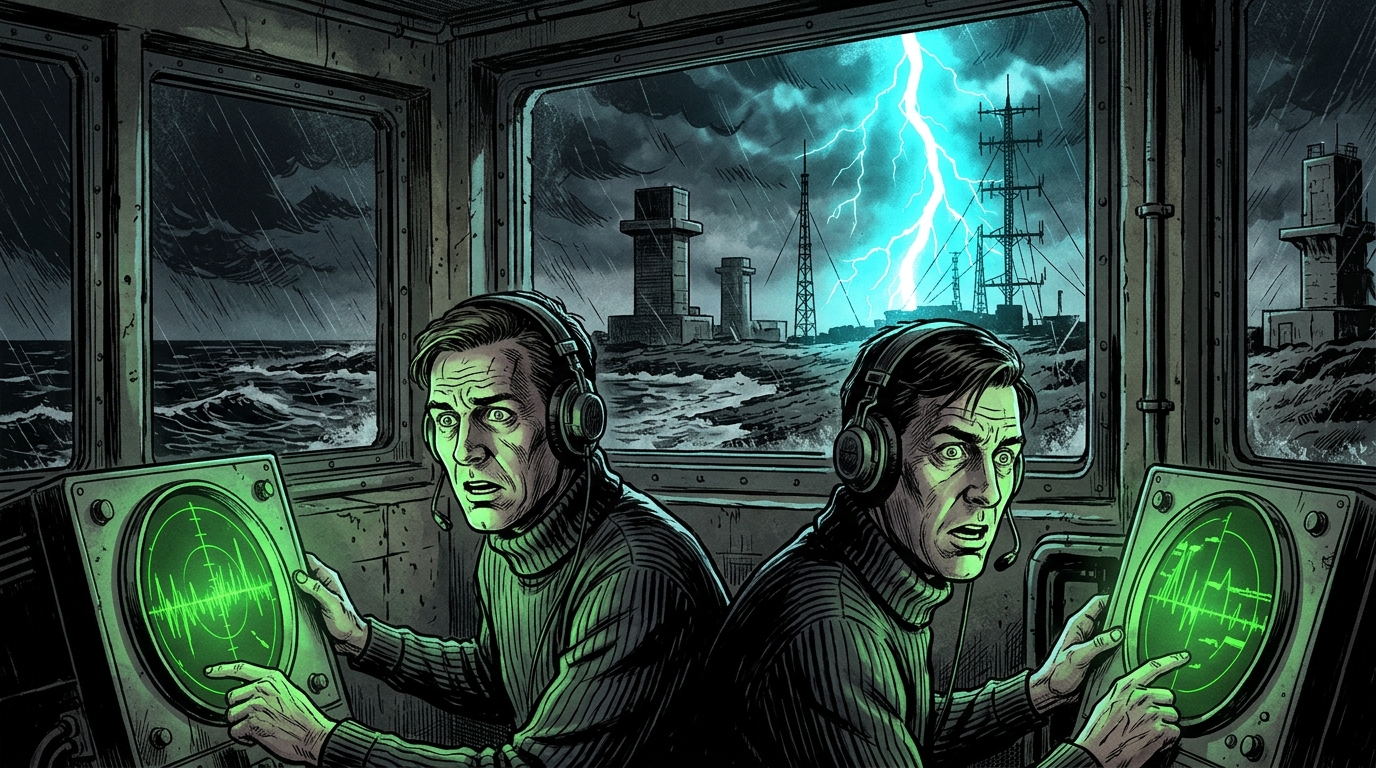
‘And the rumours?’ asked a grey-haired woman near the end of the table, her fingers steepled. ‘Our monitors in the British defense archives flagged an unsolved 1970 incident at an over-the-horizon radar station on the Suffolk coast—Orford Ness. An ionospheric surge that shattered a bunker and left vitrified glass on the concrete floor. If your field destabilises—’
‘What happened at Orford Ness in 1970 is an echo of a test that will not be conducted until New Year’s Eve 2041,’ Nestor replied calmly.
He walked to the edge of the birch table, reached into his waistcoat, and set John Harrison’s gold H6 down upon the polished wood. Even dormant, the smoky crystal inside the upper glass chamber seemed to draw the light of the chandelier into its depths. ‘Every war, every catastrophe, and every revolution you read of in your histories is already part of the architecture that brought me to this room,’ Nestor said, leaning forward on his palms until his dark eyes locked onto Viktor’s. ‘Give me until August 2042. When Dr White completes the primary Time Displacement Core, we will no longer be subject to the future. We will own it.’
Around the table, no one spoke again of quarterly returns. Looking from the eighteenth-century watch to the young man standing above them, the seven directors understood for the first time that they were not the masters of the syndicate at all—they were merely the scaffolding.