As soon as Peck stepped into the study, he knew that something was wrong.
Halting on the threshold and letting his eyes adjust to the smoky March twilight, he took in the familiar clutter of the room. At first glance, everything appeared much as it did on any other evening. The brass balance wheels, callipers, and jeweller’s loupes lay ranged across the great mahogany workbench; a hundred pendulums and escapements ticked in ragged chorus along the panelled walls; and his master sat slumped in the high-backed armchair beside the hearth. The warmth of the coals and the rhythmic whispers of the clocks often lulled the old man to sleep before supper.
Then Peck saw the floor.
A crystal wine glass lay shattered upon the oak boards, and from it a dark puddle of claret had spread like a huge crimson rose beneath the hand hanging loosely over the chair’s arm, the pale fingertips brushing the wood.
Peck hurried across the paper-strewn carpet to where his employer and friend sat motionless. ‘Master Harrison, sir?’ he said, his voice catching in the quiet room. ‘Sir, it is I, Peck. Wake up, sir.’
There was no movement, not even the faintest wheeze of breath.
Peck took the old man by the shoulders and shook him—gently at first, mindful of his master’s brittle bones, and then more vigorously as panic rose in his throat. Lifting the heavy head upright, Peck looked into the clouded, unseeing eyes and realised that no amount of shaking would ever wake him again.
And so it was that on the twenty-fourth of March 1776, in his eighty- third year, John Harrison—‘Longitude’ Harrison, conqueror of the sea’s oldest secret—was no more. And Isaac Peckham, or Peck as he was known to all who dealt with him, was thirteen years old, unemployed, and facing a very uncertain future indeed. Uncertain in far more ways than he could possibly have imagined.
Peck had served as apprentice to John Harrison for scarcely five months, acting as nimble fingers where arthritic joints fumbled and keen eyes where old sight failed in the London gloom. Standing beside the silent chair, he remembered the afternoon their paths had first crossed.
It had been near the end of the working day on a bitter afternoon in late October of the previous year. Peck was then employed as a runner of dispatches for the General Post Office in Lombard Street, and on the afternoon in question he had been handed a sealed packet to deliver to the house on Red Lion Square.
Arriving on the doorstep with the rain soaking through his thin woollen jacket, Peck had rapped smartly with the iron knocker and waited. After a considerable interval, the heavy door was wrenched open by a dishevelled old man in a grease-spotted waistcoat who barked, ‘What!’
He had plainly been disturbed at some delicate task. Momentarily struck dumb by the ferocity in the old man’s brow, Peck had held out the packet and stammered, ‘A letter for you, sir. It’s marked urgent—from Doctor Maskelyne at Greenwich.’
The name had worked a strange change upon the clockmaker. Harrison had stood on the threshold rubbing his stubbled chin for what felt to Peck like an eternity before glancing down at the shivering boy’s boots. ‘Come inside, young man,’ he had growled, stepping back into the hall. ‘It’s perishing cold out there.’
Once the street door was bolted against the wind, Harrison had broken the wax seal, squinted at the cramped handwriting near a candle sconce, and suddenly turned a sharp gaze upon the messenger.
‘Read, can you?’ Harrison had asked.
The question had caught Peck entirely off guard. It was rare enough for a boy from the Fleet ditches to know his letters, and it was common knowledge across London that the General Post Office made a strict point of employing only the illiterate as runners, owing to the sensitive nature of diplomatic and commercial correspondence.
‘Yes, sir,’ Peck had replied, straightening his shoulders. ‘Learned it myself, sir. Off old broadsheets and parish Bibles.’
Harrison had stared at him for a long moment. Age was getting the better of the great mechanic, and he knew it. His eyes watered in the tallow light, and his swollen knuckles could no longer coax a hairspring into its collet without trembling. With his secret labour on a sixth timepiece approaching its most perilous stage, he needed help— someone quick-witted, loyal, and utterly invisible to the grandees of the Royal Society.
‘Listen to me, young man—what is your name?’
‘Isaac Peckham, sir. People call me Peck.’
‘Well, Peck, I have a situation for you if you have the stomach for it. I daresay running puddles for the Post Office has its charms, but I have work here that will challenge your mind a good deal more.’
Within a month, Peck had moved his meagre bundle of clothes into the attic room at Red Lion Square. At first, the duties were hardly as grand as he had pictured: sweeping brass filings from the floorboards, oiling the lathes, reading the newspapers aloud over breakfast, and holding the magnifying glass steady while his master cursed at tiny pinions. Yet week by week, as Harrison’s strength ebbed with the winter fogs, more of the intricate assembly fell to Peck’s steady hands.
It was shortly before Christmas in 1775 that Peck first glimpsed the secret at the heart of the house.
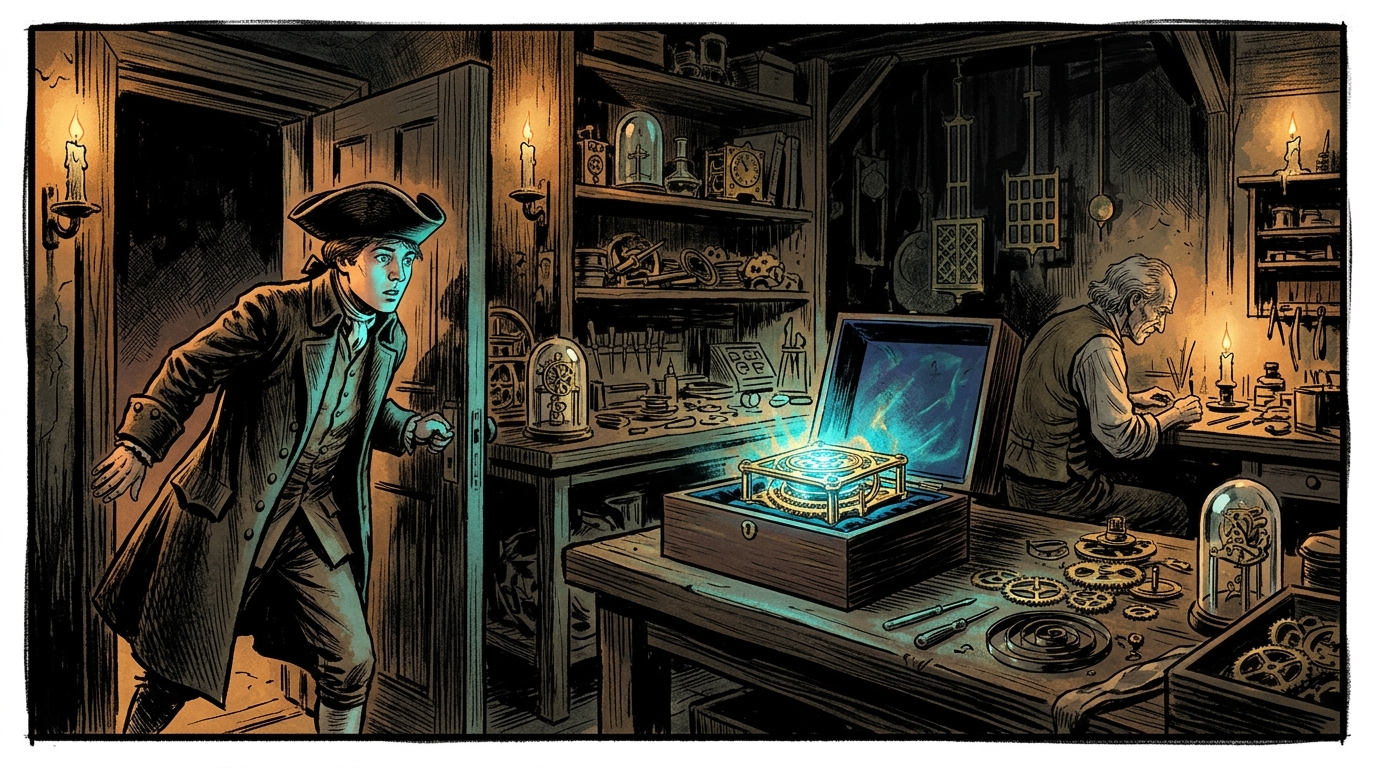
He had been kept working late into the night in the downstairs workshop, truing the teeth of a brass escape wheel. A little after ten o’clock, finding his iron file too coarse for the finish required, he decided to go up to the first-floor study to fetch a set of smooth Swiss files from his master’s cabinet.
As he reached the upper landing, he saw a thin ribbon of light seeping from beneath the closed study door. From within came the muffled sound of someone stumbling heavily against the furniture. Peck frowned. Earlier that evening, complaining of a chill in his chest, Harrison had announced his intention of retiring to bed by eight.
Before Peck could knock, the pale yellow glow beneath the door—no brighter than a single tallow dip—erupted.
Shafts of fierce, blue-white brilliance lanced through the keyhole and every crack in the door-frame, so intense that Peck threw up an arm to shield his eyes. For several seconds the corridor was lit like noon; then, without a sound, the light vanished.
Peck stood frozen on the landing, rubbing his dazzled eyes, his heart thumping against his ribs.
‘Master Harrison?’ he called softly.
Taking his courage in both hands, he turned the brass handle and pushed the door open.
The study was empty.
Peck stepped cautiously onto the Persian rug, looking from the shadowed bookcases to the heavy velvet curtains drawn across the street windows. There was nobody in the room. Yet as he crept toward the great workbench, he saw his master’s buckled shoes sitting neatly side by side beneath the desk. The coal fire in the grate had been recently built up, and upon the blotter stood a half-drunk glass of claret. When Peck laid his palm against the leather seat of the armchair, it was still warm. Someone had been sitting there mere moments before; he would have sworn to it before a magistrate.
‘Sir?’ Peck called out, louder now, backing out onto the landing. ‘Sir, where are you?’
Snatching a lit oil lamp from the hall table, he searched the bedchamber, the parlour, and the scullery, half wondering whether the old house harboured a ghost before dismissing the notion as nursery nonsense. Finding every room deserted, he concluded with an uneasy shiver that his tired eyes must have played a trick on him, and turned back toward the stairs to collect the Swiss files he had come for in the first place.
He was three steps from the upper landing when a heavy thud echoed from inside the study, followed by the unmistakable sound of a body being dragged across the oak floorboards.
At the same instant, the air on the stairs filled with a sharp, acrid stench of singed wool and brimstone.
Peck bolted up the remaining steps and flung the study door wide.
Sprawled face-down in the centre of the carpet—where there had been nothing but empty wool sixty seconds earlier—lay John Harrison.
His broadcloth coat was smeared with grey ash, and wisps of steam and acrid smoke were rising from his sleeves. As Peck dropped to his knees beside him, he saw that the skin on the old man’s wrists and cheeks was blistered an angry, raw scarlet, like a sailor’s sunburn after a month in the tropics. The smell rolling off him was like a hearth raked out on a damp morning—sooty, metallic, and thick with sulphur.
Clenched tight in Harrison’s scorched right fist was a glint of polished gold: a large pocket watch of the sort he had built for the Admiralty, save that where the winding stem should have stood, a blown-glass bulb the size of a walnut was mounted to the casing. Inside that glass chamber, a multifaceted crystal was fading from a fierce, swirling blue to a dull ember.
‘Sir! Are you all right, sir?’ Peck cried, terrified that his master was done for. Harrison gave a ragged cough and rolled onto his side, his chest heaving. ‘Get me some water, boy,’ he rasped.
Peck scrambled to his feet and pelted down the dark stairs to the kitchen pump. Yet when he hurried back into the study less than two minutes later carrying a brimming earthenware jug, the floor was empty.
John Harrison was standing upright beside the workbench, methodically brushing the grey ash from his lapels with the fireside hearth-brush. The smell of scorched cloth and sulphur still hung heavy in the room, but the gold watch with the glass chamber was nowhere to be seen.
‘Peck,’ Harrison said, his voice iron-hard despite the tremor in his blistered hands. ‘Look at me, boy.’
‘Yes, sir.’
‘I want your solemn word that you will never repeat to a living soul what you have seen in this room tonight. Do you understand me?’
‘Of course, sir,’ Peck said, setting the jug down. ‘Only—what was that timepiece you were holding, sir? I wasn’t aware we were building another watch.’
‘Forget what you saw,’ Harrison snapped, turning back to his papers. ‘It is none of your concern, and it is a thing no man was ever meant to wind. Go back to your bench—no, wait, Peck!’ His tone softened a fraction as he glanced at the longcase clock in the corner. ‘Go home to your bed. It is past eleven, and we have a full day’s work tomorrow.’
Scratching his head and more baffled than ever, Peck had climbed the narrow stairs to his garret and lain awake until dawn, staring at the plaster ceiling and trying to picture the miniature storm of stars he had seen dying inside his master’s fist.
Now, three months later, standing beside the spilled claret and the cooling corpse of the man who had made it, Peck looked toward the locked drawers of the workbench. His master was gone—which meant that whatever lay inside that glass chamber was now entirely unprotected.