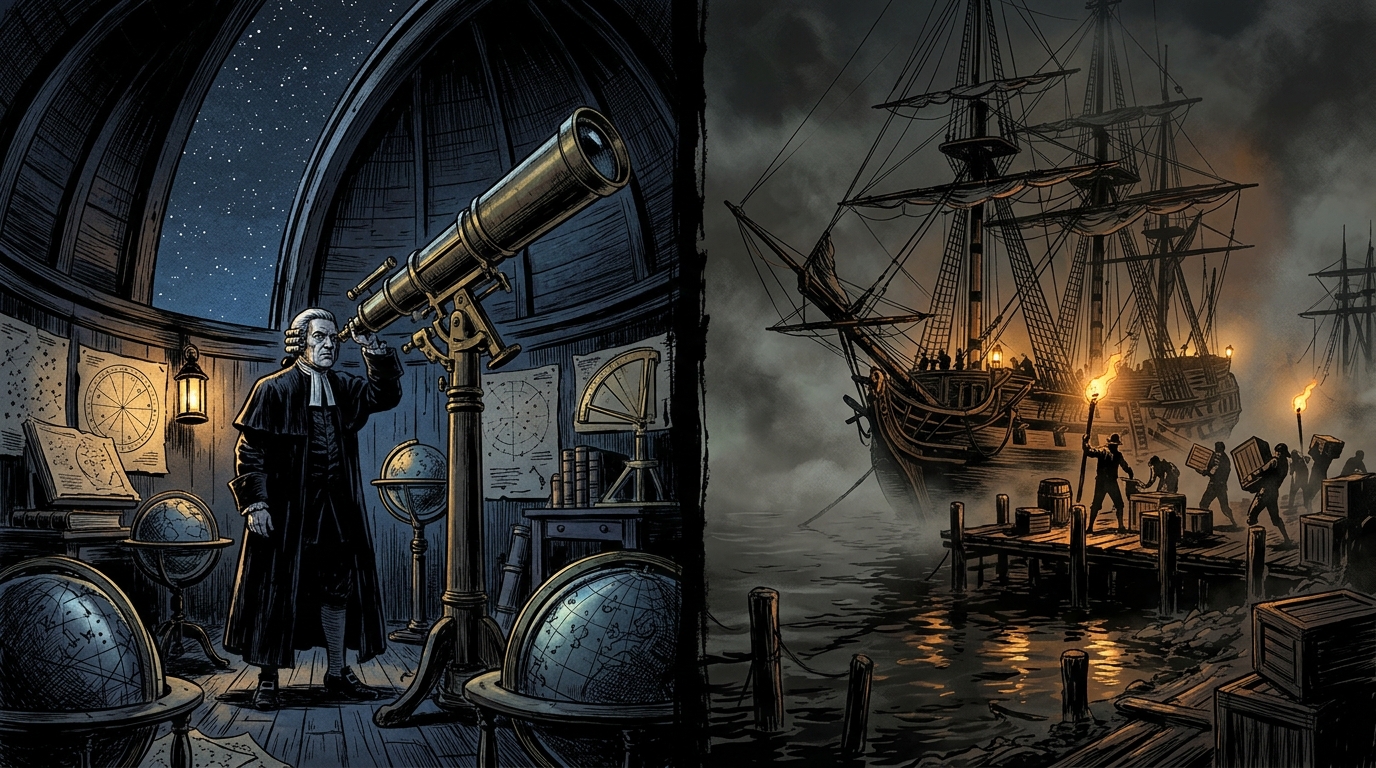
Sixteen months before John Harrison breathed his last in Red Lion Square, the Reverend Doctor Nevil Maskelyne sat at his desk in the Octagon Room of the Royal Greenwich Observatory and watched a November squall lash the trees in the park below.
The Deptford merchant with whom the Astronomer Royal had just taken luncheon had left him with an itch in his mind that refused to be quieted.
What is Harrison up to now?
Maskelyne had known for months that the old carpenter in Bloomsbury was hiding something, and he had never forgiven Harrison for the humiliation of the longitude trials. That an unlettered Yorkshire joiner with a box of brass wheels should triumph over Maskelyne’s own God- given solution—the sublime, mathematical perfection of the lunar- distance tables—was an insult that had curdled into pure, waking hatred.
And now this absurd talk of eastern superstitions and a glowing stone from India. In Harrison’s own house, of all places! Word had already reached Greenwich through the trade coffee-houses that Harrison was spending every waking hour on a secret sixth chronometer, and that earlier in the autumn he had quietly engaged the services of a master diamond cutter and polisher from Antwerp.
To any other fellow of the Royal Society, a dockside yarn about magical Indian crystals would have been dismissed as tavern twaddle. To Nevil Maskelyne, it fitted together like the teeth of an escapement.
The merchant, one Mister Samuel Hoy of Deptford, owned the freehold to a private deep-water mooring on the Thames a quarter-mile upstream from his counting-house. On a bright morning in September 1774, Hoy had been approached by a family of Indian merchants who had traded spices, calico, and teak between Calicut and the Pool of London for more than a century.
Through four generations, the Shah family had kept scrupulous ledgers of every transaction completed in every port they had visited since the reign of King Charles II, and it was a curious discrepancy in one of those seventeenth-century accounts that had eventually led Hoy to seek out his friend Doctor Maskelyne.
Having agreed a handsome rent for the mooring, Hoy had grown passably friendly with the Indian traders, pausing on the wharf of an afternoon to pass the time of day regarding river tariffs and the autumn winds. Eventually, he had been invited aboard their vessel to dine—an invitation Hoy had accepted with some reluctance, given the pungent aromas of cardamom, turmeric, and roasted mutton that drifted from their galley, though as they paid in good gold sovereigns he deemed it a courtesy required by trade.
Late that evening, while the younger nephews cleared the dishes and saw to the ship’s lanterns on deck, Hoy had been invited down into the great stern cabin by the patriarch of the family to take coffee and tobacco.
The elder, a man named Anup Shah, was extraordinarily old—his face a web of deep mahogany creases, his eyes filmed with the milky ring of great age. As the rain pattered against the stern windows and the brazier glowed between them, Anup had spoken of his first voyage to the docks of London as a small boy, and of his father’s fateful dealings with an English trading firm by the name of Browne.
‘They were a strange, bumbling pair, the elder Mister Browne and his wife,’ Anup had said softly, resting his knotted hands atop his ivory- headed cane. ‘They vanished during the Great Fire without ever settling their final account, leaving their son Bartholomew to inherit the shop at the corner of Dane Street and Red Lion Square.’
Hoy had nodded politely over his porcelain cup as Anup described his father’s lingering distress over an item included by mistake in that final job lot of Malabar goods—an uncut, fist-sized crystal of ancient Indian provenance.
‘My father, Raahi Shah, pleaded with old Mister Browne to return the stone,’ Anup continued, his voice dropping to match the creak of the ship’s timbers. ‘When Browne refused, claiming a bargain struck was a bargain kept, my father begged him at least to lock it away where no hand could touch it. In early September of 1666, while the eastern wards of the city were already beginning to burn, my father grew convinced that Browne would meddle with the thing. He walked to Red Lion Square before seven o’clock in the morning, hoping to catch the shopkeeper before business began.’
Instead, Anup explained, Raahi had found the shop unlocked and entirely deserted—and the crystal lying bare upon the floorboards where the elder Brownes had stood.
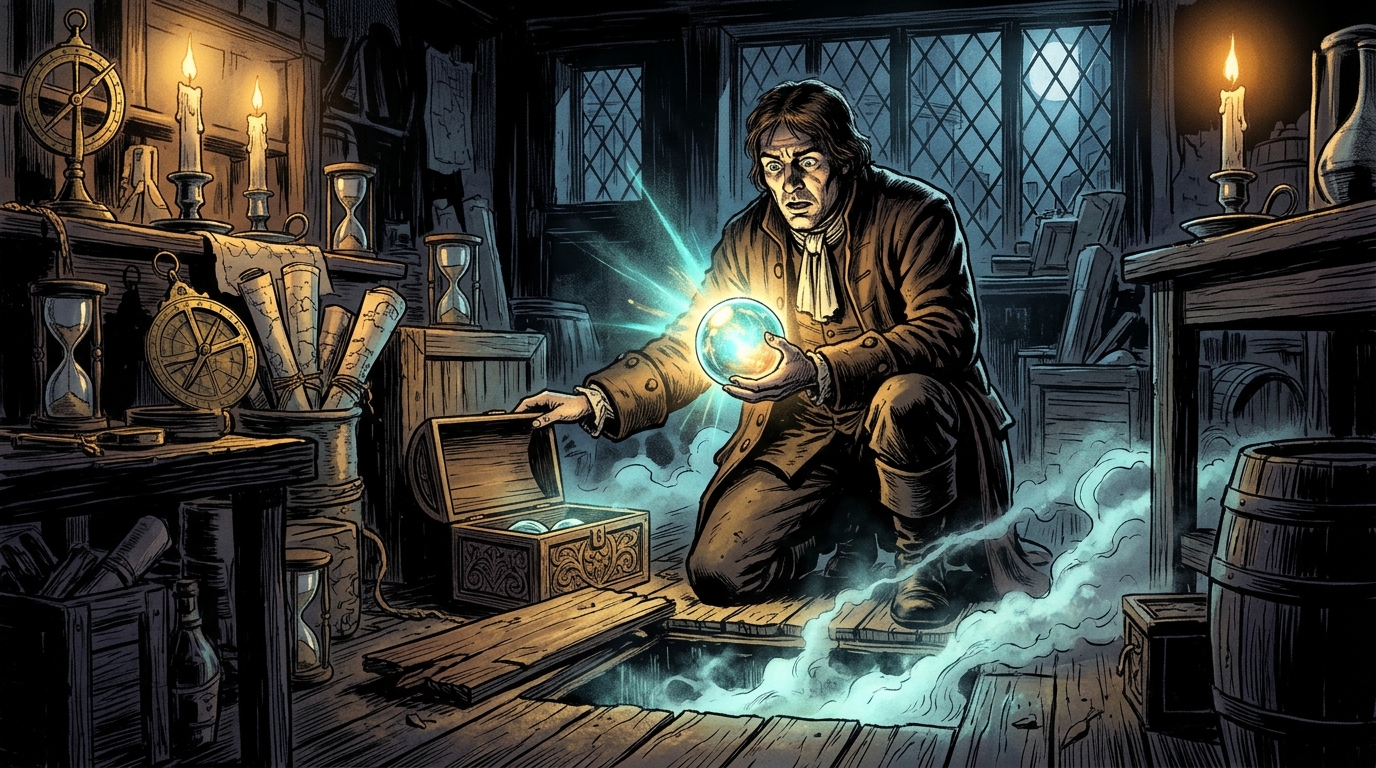
‘Realising at once what catastrophe had befallen them, my father resolved to conceal the stone without touching its naked surface,’ Anup told Hoy. ‘Using the hem of his cloak, he placed the crystal inside a small oak box he found upon a shelf and wedged the lid fast. With a knife from Browne’s desk he scraped away the varnish on the lid, took up a quill, and wrote his own name and a warning across the raw wood. Then he prised up a floorboard in the rear storeroom, laid the box in the darkness beneath the joists, and walked out of the shop forever.’
In the warm cabin, Hoy had set down his empty coffee cup, frowning through the blue pipe-smoke. ‘A remarkable family history, Mister Shah. Though if you will forgive an honest man’s arithmetic, I was just attempting to calculate your own years. If you visited London not long after the Great Fire, that would make you—’
‘Over a century old,’ Anup finished quietly, a faint smile touching his withered lips.
Hoy had shifted uncomfortably on the cushioned bench, wondering whether the old gentleman’s wits were wandering. Anup had eyed him shrewdly, called to his grandson for fresh coffee, and poked the glowing charcoal with the tip of his cane.
‘You think an old sailor is spinning you fables, Mister Samuel,’ Anup said. ‘I am telling you the plain truth. My father neither wanted that crystal back nor dared let another man use it, so he buried it under Red Lion Square until the world should grow wise enough to let it die. Come —drink your coffee, and let me tell you a story from the Malabar coast. A tale that was already a thousand years old when the Portuguese first dropped anchor in Calicut.’
Clasping his thin hands together, Anup had begun to speak, his rhythmic cadence and the crackle of the brazier soon drawing the sceptical Londoner into an almost hypnotic stillness.
‘One day, some fifteen hundred years ago in southwestern India,’ Anup began, ‘a poor young fisherman was walking along the red mud by the sea when he came upon a crowd of village children tormenting an injured eagle. Do you know what an eagle is, Mister Samuel?’
‘To be sure,’ Hoy said. ‘Go on.’
‘The fisherman had a gentle heart toward all creatures of the air,’ Anup continued. ‘He drove the cruel children off, sheltered the broken bird beneath his coat, and sought to nurse it back to the sky. In the story the villagers tell, the god Vishnu appeared to him the next day, revealing that the bird he had pitied was none other than Garuda, the divine eagle mount of heaven. In gratitude, Vishnu granted the fisherman wings of light and carried him up to the heavenly Palace of the Gods, where he was welcomed by Vishnu in the form of the enchanting female avatar, Mohini.’
Hoy had smiled faintly and looked down at his boots, trying hard not to betray his robust Protestant opinion of heathen mythology.
‘Shall I continue, Mister Samuel?’ Anup asked mildly.
Flushing slightly, Hoy returned his gaze to the fire and nodded.
‘The fisherman remained in that shining palace for what seemed to him only a few days,’ Anup said, pulling himself upright on his cane. ‘Yet soon his heart ached for his humble village and his ageing, feverish mother. He begged Mohini for leave to return home. Sorrowfully, she granted his wish, placing in his hands a small sealed casket containing a radiant stone, which she bade him never to open and never to touch with his bare skin.
‘Clutching the casket, the fisherman leapt from the clouds and found himself standing once more upon the familiar seashore of Calicut. Yet when he walked up the dirt track toward his village, everything had changed. His thatched hut was gone; his mother had vanished; the faces and tongues in the harbour were strange to him. Upon asking the elders, he learned to his horror that three hundred years had passed since the day he vanished in the storm.
‘Stricken with unbearable grief, the fisherman forgot the goddess’s warning. He broke open the casket and touched the stone within. At once a blinding cloud of white fire burst forth, tearing him from the earth and hurling him more than a thousand years further into the future. And as he fell through the blinding light, the sad, sweet voice of Mohini echoed from the heavens: "I told you not to open that box. It contained your destiny…"’
Anup paused, looking deep into the eyes of Samuel Hoy, who was now sitting on the very edge of the cabin bench.
‘You see, Mister Samuel,’ the old Indian whispered, ‘that fisherman was no fable. He was my father, Raahi Shah. He should never have broken the latch in that sea-cave, and he should never have rubbed the dust from that crystal. Only sorrow and displacement can come of it.’
When Hoy finally rose to take his leave on deck, Anup had gripped his coat sleeve with surprising strength. ‘Wait, my friend. Promise me you will never repeat what I have told you tonight to any man of ambition.’
Hoy had given his word readily enough, thanked his host, and walked back along the dark towpath of the Thames toward Deptford. Yet as his boots crunched over the riverside gravel, he had replayed the tale over and over in his head—until a sudden jolt of recognition stopped him dead under a street-lamp.
Red Lion Square, at the corner of Dane Street, he thought. That is the house old John Harrison bought—the clockmaker!
Three weeks later, over roasted capon and claret at Greenwich, Samuel Hoy had repeated the story word for word to his influential friend, the Astronomer Royal.
Feigning polite indifference as he dabbed his lips with a napkin, Doctor Nevil Maskelyne had listened with every nerve taut. When Hoy departed down the hill, Maskelyne remained at his window until dark. He wanted that crystal—and he was prepared to break the King’s law, and God’s law beside it, to tear it from John Harrison’s grasp.