Some myths are merely fireside fancies, spun by old men to pass the monsoon nights, and some are born of real blood and real salt, handed down from father to son until the truth is worn smooth as a sea-pebble.
The Fisherman and the Eagle was such a myth.
Long before he brawled with a clockmaker’s apprentice in a London tavern or hid a wooden box beneath the floorboards of Red Lion Square, Raahi Shah was a young man of twenty living in a small Sangam fishing village on the Malabar coast of southwestern India.
It was the year 13 AD. Along the curve of the shore where the trading port of Calicut was beginning to take shape, there were no stone pavements, no cobbled squares, and no dressed quays—only tracks of packed red earth scarred by the wooden wheels of bullock carts and churned to crimson mud whenever the rains broke.
Raahi had spent the twenty years of his life watching his uncles mend their nets and learning the ways of the Arabian Sea, though he owned neither boat nor tackle of his own. His father had drowned in a squall when Raahi was still a child, leaving the boy to be raised by a mother who had grown frail far before her years. They survived on the meagre copper coins Raahi earned wading neck-deep through the surf to haul the day’s catch in heavy wicker baskets from the canoes up the red-dirt tracks to the village drying-racks.
He had dreamed since boyhood of commanding a teak dhow of his own, yet his uncles refused to take him out beyond the bar. Fishermen are a superstitious breed, and it was whispered along the beach that Raahi carried his father’s ill luck in his bones, and that the sea which had claimed the sire was only waiting its hour to take the son.
On a wild afternoon at the onset of the monsoon, when the rollers were crashing too fiercely over the sandbank for a single boat to launch, Raahi walked alone along the storm-lashed beach to watch the waves. His mother lay burning with fever in their low mud-and-thatch hut, and he had not two coppers to buy her grain.
As he rounded the spit where the red mud of the estuary met the surf, he saw a knot of seven or eight boys—the well-fed sons of village spice- brokers—hooting and jeering around some creature that lay thrashing in the wet silt.
Striding closer through the spray, Raahi saw at once that the animal was a great sea-eagle. One of its broad, golden-brown wings had been snapped by the gale, and its fierce yellow eyes were clouded with exhaustion as the boys poked at its breast with pointed bamboo sticks and lifted a heavy stone to crush its skull.
‘Back!’ Raahi roared, his voice cutting across the thunder of the surf as he waded into the circle and knocked the leader’s stone into the mud. ‘Leave the bird be! Go back to your fathers’ granaries before I lay this stick across your backs!’ Startled by the fury of the tall pauper they usually ignored, the boys scattered like sand-crabs into the palms, flinging curses over their shoulders.
Raahi dropped to his knees in the red mud. Taking off his ragged cotton coat, he wrapped it gently around the shivering, brine-soaked feathers to bind the broken wing against the bird’s flanks, then lifted the eagle into his arms.
He had intended to carry the creature back to his hut to show his mother, but as he turned toward the village, the sky above the sea turned the colour of bruised lead and the first sheets of torrential rain began to lash the coast, dissolving the dirt tracks into rivers of red mire. Half- blinded by the downpour, Raahi climbed the rocky path toward a deep limestone cave in the sea-cliffs where fishermen sometimes sheltered when caught out by a squall.
Ducking inside the jagged mouth of the cavern as lightning forked across the water, Raahi set his bundle down on a dry ledge and gathered an armful of driftwood twigs and dry palm-fronds left in the hollow. Striking a spark with flint and iron, he blew a small fire to life against the creeping chill.
Only when the flames began to crackle did he notice that the bundle beside his knee had ceased to stir.
With a sinking heart, Raahi parted the folds of his coat. The great eagle lay still, its head limp against the cloth, its golden eyes closed forever. The storm and its injuries had been too much for it.
‘I am sorry, brother,’ Raahi whispered, touching a finger to the wet plumage. ‘I came too late for you.’
As he sat huddled in the gloomy twilight of the cave, listening to the rain drum against the cliff face outside, a tiny point of reflection caught the corner of his eye—a faint metallic glimmer beneath a pile of fallen limestone shards against the rear wall.
Curious, Raahi rose and rolled the heavy stones aside.
Half-buried in the dry cave-dust sat a small iron-bound casket. It looked extraordinarily old, its corners crusted with red rust from decades in the salt air, as though it had been abandoned in haste rather than buried.
As Raahi lifted the heavy casket from the hollow, he froze.
From the deeper shadow directly behind the rocks, a face was staring back at him.
Startled, Raahi dropped the casket with a clatter onto the shin-bones of a desiccated corpse propped upright against the limestone wall. Snatching a burning branch from his fire, Raahi held the torch high and peered trembling at the dead man.
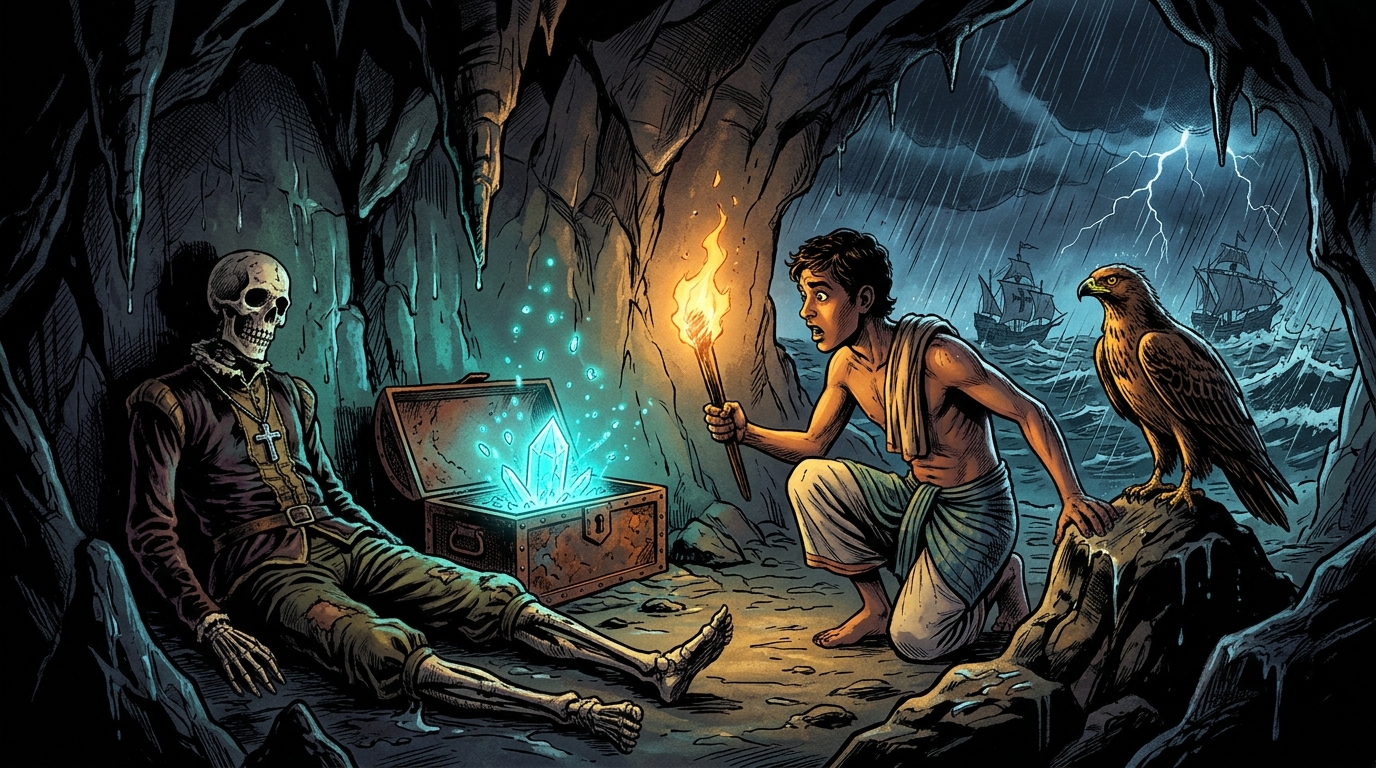
It was the dried, parchment-skinned skeleton of a bearded stranger dressed in garments unlike any woven in Malabar—heavy, rotted woollen breeches and a tattered doublet of dark velvet, with a tarnished silver cross hanging from a chain around his neck. The dead man’s right arm was extended across his knee, a single bony finger pointing rigidly at the smooth rock wall beside his shoulder.
Holding the torch closer, Raahi saw that words had been laboriously scratched into the limestone with the point of a dagger, written in an angular script he had never seen in his life:
Seu destino é aqui amigo. Buscar em seu perigo. Deus não irá protegê-lo à luz do cristal.
Having not the faintest notion what the foreign markings meant, Raahi stood scratching his head, looking from the grinning skull to the inscription and back to the rusted box at his feet.
Whatever had killed the stranger, the casket remained sealed. What if it held gold coin or jewels from some wrecked merchantman across the ocean? With a single gold piece he could buy medicines for his mother and a stout fishing boat of his own.
Carrying the casket to a flat slab of granite beside the fire, Raahi selected a sharp wedge of stone and brought it down with all his might upon the corroded iron hasp. At the third blow the metal gave an audible crack, and the lid sprang open a finger’s breadth.
Holding his breath, Raahi lifted the lid. There were no coins within. Wrapped in a square of rotted velvet lay a single uncut rock of clear crystal or heavy glass, roughly the size of a man’s fist and coated in grey dust.
Reaching into the box, Raahi lifted the stone out and held it up to the light of his driftwood fire.
He gasped. The object was not dead mineral at all; deep within its translucent heart, tiny points of white fire and milky nebulae were swirling in a slow, mesmeric circle, as though someone had bottled a piece of the night sky.
Unable to believe his eyes, Raahi wiped the crystal vigorously against the front of his damp shirt to clear away the grime and see the stars more clearly.
Instantly, the stone grew burning hot against his palm. A silent, terrible radiance erupted from its facets, blinding him and filling the sea-cave with a roar like a breaking wave. Raahi felt the rock floor vanish beneath his heels as though he had stepped off the cliff into a bottomless chasm. Down and down he plunged through icy dark until he struck stone with a force that knocked the senses clean out of his skull.
When Raahi opened his eyes, he was shivering, ravenous, and nursing a throbbing bruise across his cheekbone where he had struck the cave floor.
The driftwood fire was gone—not merely burned out, but vanished without leaving a smudge of ash. Outside the cavern mouth, the monsoon storm had given way to blinding, cloudless sunshine.
Pushing himself unsteadily to his feet, Raahi noticed that his surroundings felt subtly, unnervingly altered, though at first he could not say how. Then he looked out through the mouth of the cave toward the sea—and his breath caught in his throat.
Anchored across the bay rode a dozen towering ships with high, castellated sterns and great square sails emblazoned with red crosses— vessels ten times the size of the largest dhow he had ever seen. And where the empty red-dirt track and palm groves of his village had stood an hour before, a sprawling port of whitewashed stone warehouses, tiled roofs, and timber jetties stretched along the curve of the shore.
Remembering the crystal, Raahi turned back, scooped it up from the cave dust where it had rolled, slipped it into his waistband wrapped in cloth, and stepped out into the glare of day.
He nearly tripped over a stack of tarred hemp ropes and wooden cargo crates piled right outside the cavern entrance. A crowded dirt highway ran past the cliff base, thronging with bullock-carts, elephants hauling timber, and hundreds of people shouting in unfamiliar tongues.
As Raahi stumbled down the road toward the waterfront, his eyes widened in creeping dread. Striding up and down the stone quays among the local dockworkers were bearded, pale-skinned sailors wearing heavy woollen breeches, velvet doublets, and silver crosses around their necks—men dressed in the exact style of clothing worn by the ancient skeleton sitting in the cave behind him.
There had to be a connection, yet his mind reeled when he tried to grasp it.
At the harbour wall, a crew of dark-skinned fishermen were unloading baskets of silver mackerel from a row of large boats bobbing on the tide. Raahi caught one of the men by the arm.
‘Brother—what place is this?’ Raahi asked urgently.
The fisherman looked at him as though he were touched by the sun. ‘Why, Calicut, man—the greatest seaport on the Arabian Sea!’
‘And the village by the estuary?’ Raahi pressed, his voice trembling. ‘Do you know a widow named Shah, or her son Raahi Shah?’
The fishermen exchanged glances around their nets and shook their heads. None of them had ever heard the name.
More bewildered and frightened than ever, Raahi walked on into the heart of the bustling city. He could still recognise the outline of the headlands and the distant blue ridge of the Western Ghats, proving beyond doubt that this was his homeland—yet everything human had been swept away and replaced. Finding a shaded step beside a spice- market well, he sank down with his head in his hands, wondering whether the blow in the cave had driven him mad. Reaching into his sash, he drew out the wrapped crystal and peered once more at the stars wheeling silently inside the glass.
At that very moment, less than two hundred paces away inside a small whitewashed custom-house overlooking the quay, a Portuguese port official named Afonso Valente—newly arrived with the fleet of Dom Vasco da Gama—stood behind a high desk checking a newly landed cargo manifest. Dipping his goose-quill into an inkwell, he wrote across the foot of the parchment in a neat clerical hand:
Recebeu de grãos e especiarias. 15 de Junho de 1502.
Received grain and spices. 15 June 1502.
Afonso Valente did not yet know that within a year he would cross paths with the bruised young Indian sitting by the well, steal the star-filled crystal from his lodging in the night, and accidentally hurl himself fifteen centuries backward into an uninhabited sea-cliff cave—where he would die alone in the dark after scratching a final warning into the limestone wall in the only language he knew:
Your destiny is here, friend. Seek at your peril. God will not protect you in the illumination of the crystal.
And so it had been told for one and a half thousand years in the bustling streets of Calicut in the year 1502, and before that in the growing town, and before that around the cooking-fires of the small fishing village where Raahi had grown up: that there was once a poor young fisherman who saved a broken eagle on the shore during a storm, and was carried away to the palace of the gods never to be seen in mortal life again.
Such are the fragile threads out of which myths and legends are woven.