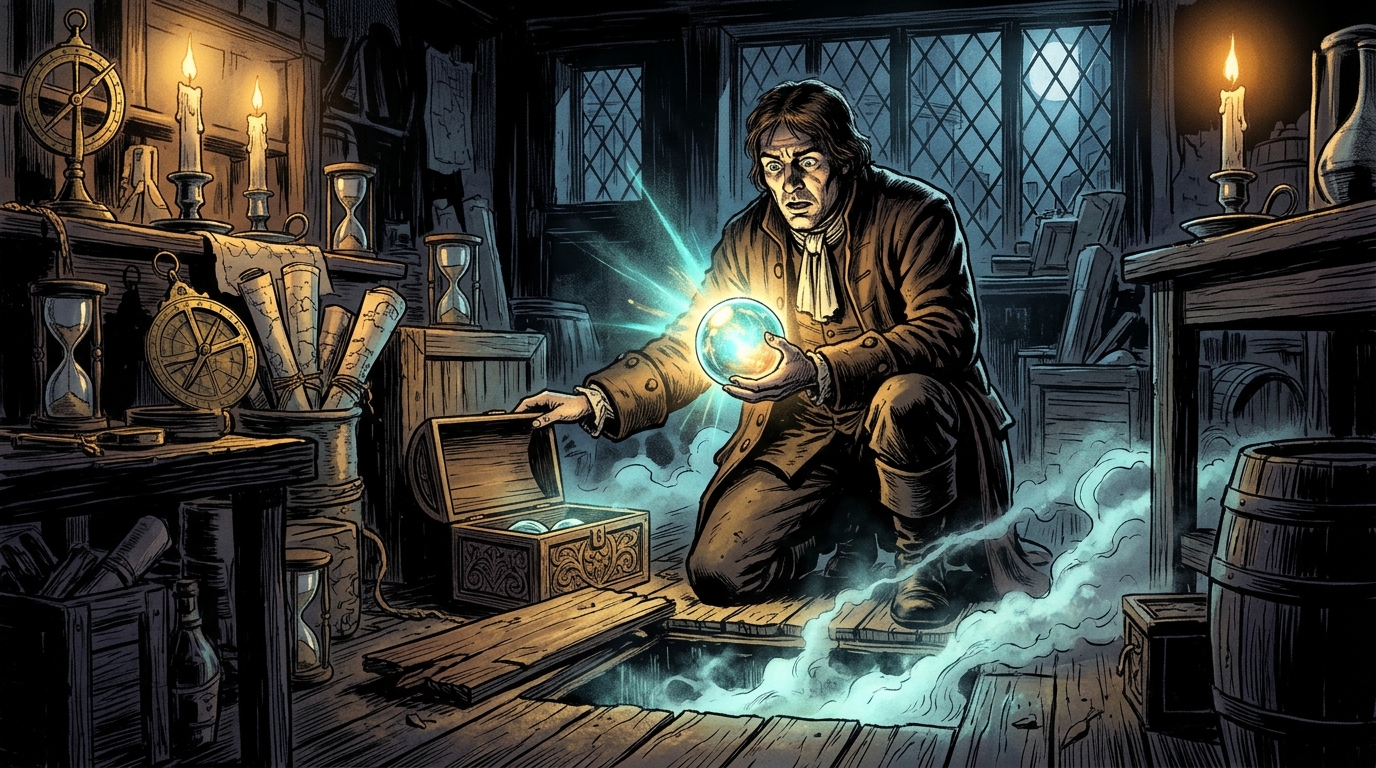
The transition from the burning rafters of Pudding Lane was a shriek of white light followed by the jarring, discordant roar of a city that had forgotten how to be silent.
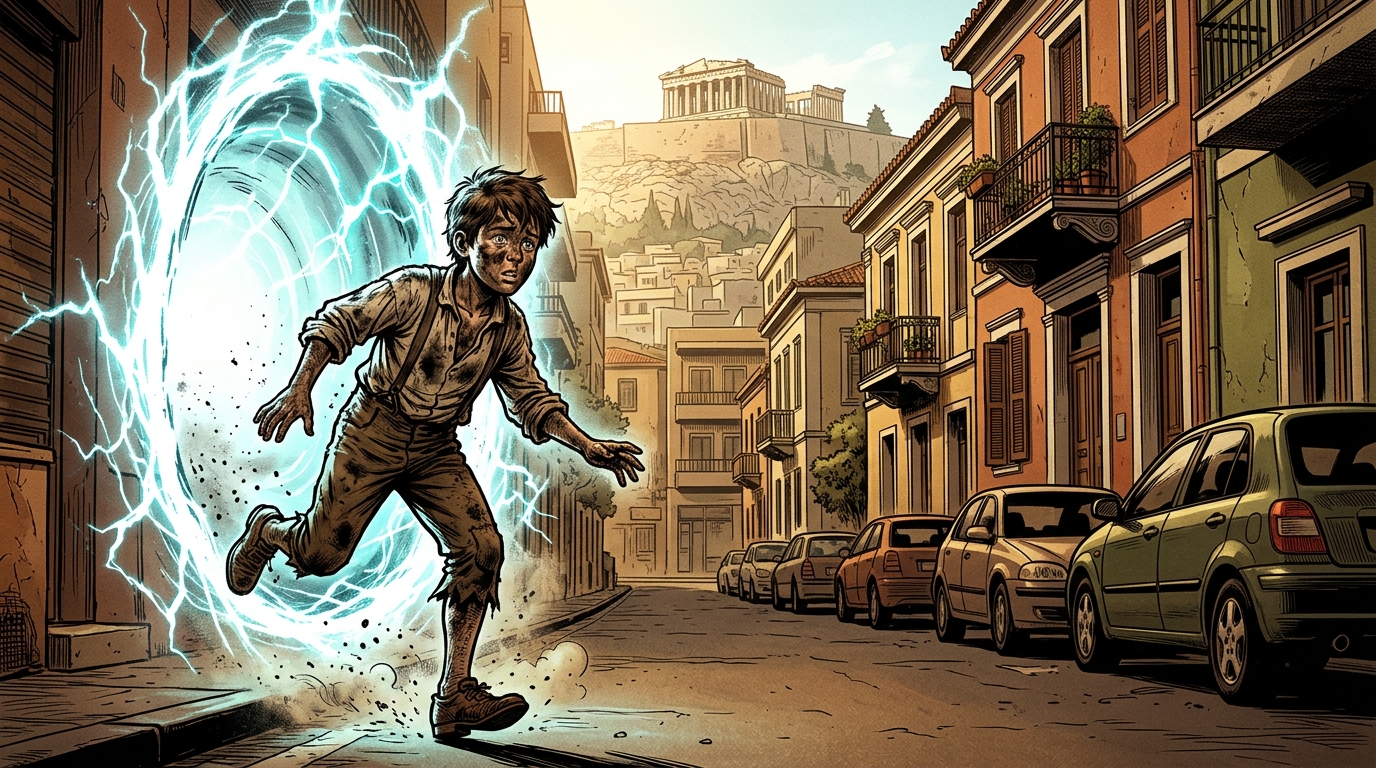
Isaac Peckham did not land gently; he was spat out of the rift three centuries and forty-five years down the line, striking the sun-baked asphalt of a narrow side street in central Athens with a force that rattled the teeth in his jaws.
He lay gasping in the blinding Mediterranean glare, coughing up lungfuls of seventeenth-century woodsmoke while his bruised knees scraped against hot tarmac. His woollen breeches and collarless linen shirt were blackened with the soot of 1666, and in his blistered right hand he still clutched the heavy gold casing of the H6.
For the first time since he had twisted the glass bulb in John Harrison’s kitchen, the watch was completely silent. The crystal inside the quartz dome had gone dark and cold, drained by the violence of the jump, its internal pinion fused solid by the heat of the bakehouse fire.
When Peck staggered to his feet and stumbled out into the main thoroughfare, his thirteen-year-old mind nearly gave way beneath the assault on his senses.
The air was a suffocating furnace of petrol exhaust, hot bitumen, roasting lamb, and the dry, electric hum of air-conditioning units. To a boy who had known only the clatter of iron-shod cartwheels, the cry of link-boys, and the smell of tallow and horse dung, twenty-first-century Athens was a Bedlam of glass and hurtling steel. Metal carriages without horses screamed past him at terrifying speeds; towering blocks of concrete and mirrored glass blotted out the sky; and everywhere he looked, men and women walked past holding glowing rectangular panes of light in their palms, speaking to invisible companions.
For three weeks Peck lived like a stray dog on the margins of the city.
Too terrified of the uniformed police to ask where he was—and unable to understand a single word of the modern Greek spoken around him— he scavenged bruised peaches and crusts of bread from the gutters behind the central market at night and slept curled behind industrial rubbish bins in the alleys off Omonia Square. By day he hid in the shadows of concrete underpasses, turning the cold gold watch over and over in his filthy fingers, weeping silently for Master Harrison and the quiet ticking of the study in Red Lion Square.
In the fourth week of July, collapsed with dehydration and heat- exhaustion in an alleyway behind a chemist’s shop, he was found by a municipal patrol and carried by ambulance to a state children’s shelter in the northern suburbs.
He had no papers, no name that matched any registry in Europe, and rags stitched by hand in thread that baffled the hospital orderlies. For a fortnight he sat on the edge of his iron cot in the shelter ward, refusing to utter a sound.
It was there, on a bright afternoon in August 2011, that Ioannis Drakos, a secondary-school physics teacher, and his wife Eleni, a lecturer in inorganic chemistry at the University of Athens, first saw him through the observation window of the director’s office.
Childless after twelve years of marriage, the couple had come to inquire about fostering an older child. Instead, their eyes were drawn immediately to the slight, hollow-cheeked boy sitting motionless on a plastic chair in the courtyard, staring down at an antique gold pocket watch in his lap as though it were the only solid object in a dissolving universe.
‘He isn’t merely traumatised, Ioannis,’ Eleni murmured, resting her hand against the glass. ‘Look at the way he holds his shoulders. Look at his eyes. He looks as though he belongs to another century entirely—like a child waiting for a blow that is three hundred years late.’
Ioannis opened the door and stepped quietly into the courtyard, pulling up a chair a few paces from the boy so as not to startle him.
Peck did not flinch; he simply raised his dark, guarded eyes and watched the bearded stranger.
‘That is a remarkable piece of craftsmanship,’ Ioannis said gently in Greek, and then—seeing the flicker of English comprehension in the boy’s brow—repeated the words in careful, halting English, pointing toward the heavy gold timepiece. ‘Eighteenth century, unless I am mistaken. A marine chronometer. But the balance wheel… it does not move. It is broken.’
Peck looked down at the smoky quartz bulb crowning the watch. When he spoke, his voice was a dry, cracked rasp—the first sound the shelter staff had heard him make since he was brought in off the street.
‘It is not broken,’ Peck whispered. ‘It is waiting.’
Ioannis and Eleni Drakos adopted him the following spring, registering him under the name Nestor Ioannou Drakos, with an estimated birth year of 1998 provided by the municipal magistrate.
They gave him a clean bedroom overlooking a courtyard of lemon trees, taught him modern Greek and contemporary English, and treated his night terrors with unfailing patience. Yet even as the soot was scrubbed from his skin and his spare frame filled out into late adolescence, they sensed inside their adopted son a terrifying, single-minded intensity that bordered on obsession.
While other boys of fifteen kicked footballs in the street or played video games, Nestor sat until two in the morning in his father’s small study, surrounded by university textbooks on quantum electrodynamics, crystallography, and general relativity. He was trying to reconcile the arrow falling into King Harold’s eye and the roaring pine rafters of Pudding Lane with the cold differential equations on the page.
‘Why do you study the light-cones so fiercely, Nestor?’ Eleni asked one warm evening in 2015, pausing behind his desk to brush a lock of dark hair from his forehead. ‘You have time enough when you reach the university.’
Nestor did not look up from the legal pad where he was sketching the three brass coordinate wheels of the H6 from memory.
‘Because history is a trap, Mother,’ he said quietly. ‘When I tried to run away, the watch forced me to light the match. If I can map the geometry of the crystal, I can build a cage strong enough to command it.’
By the autumn of 2016, at eighteen, Nestor was enrolled as an undergraduate in theoretical physics at Zografou University in Athens, already outstripping lecturers twice his age. He believed he was forging his own path toward mastery of the timepiece locked in his desk drawer. He did not yet know that the path had been laid for him two hundred and forty years before he ever set foot in Athens.