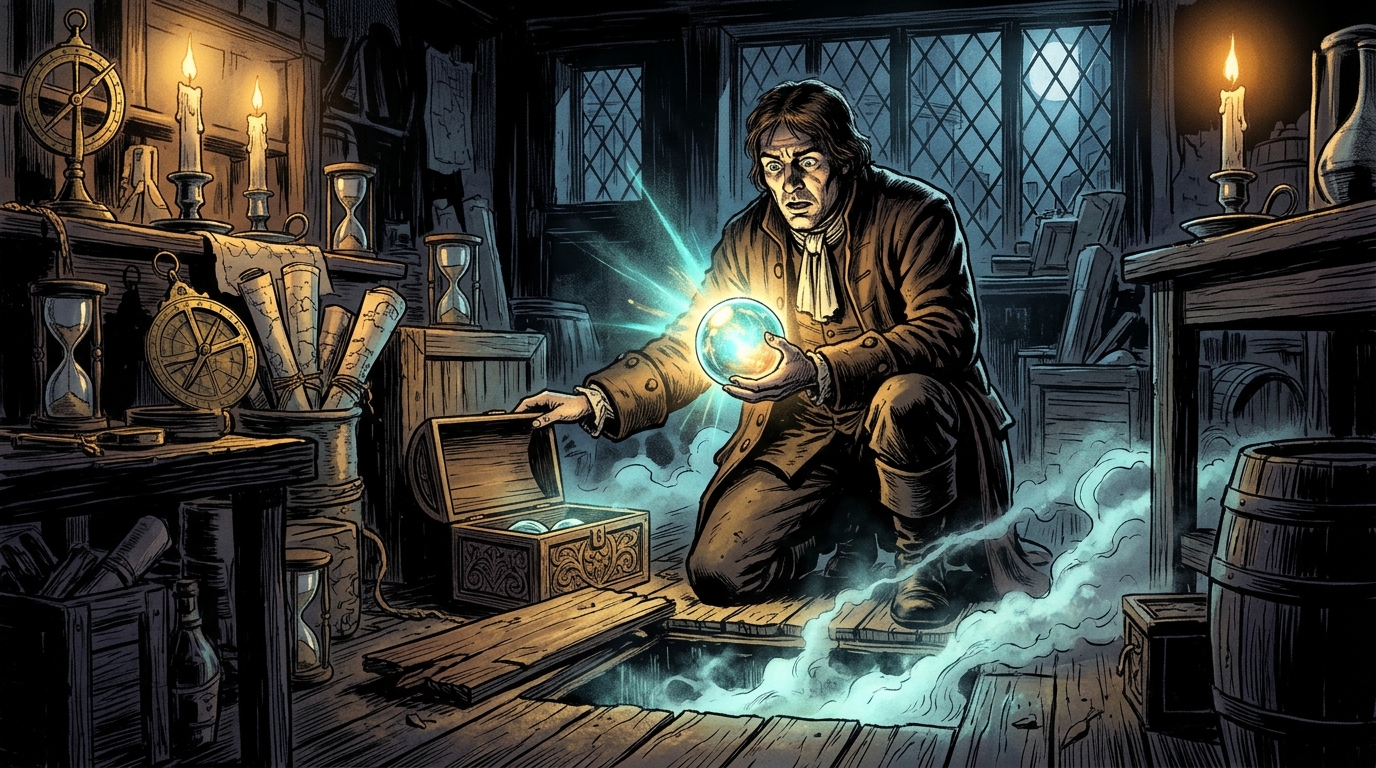
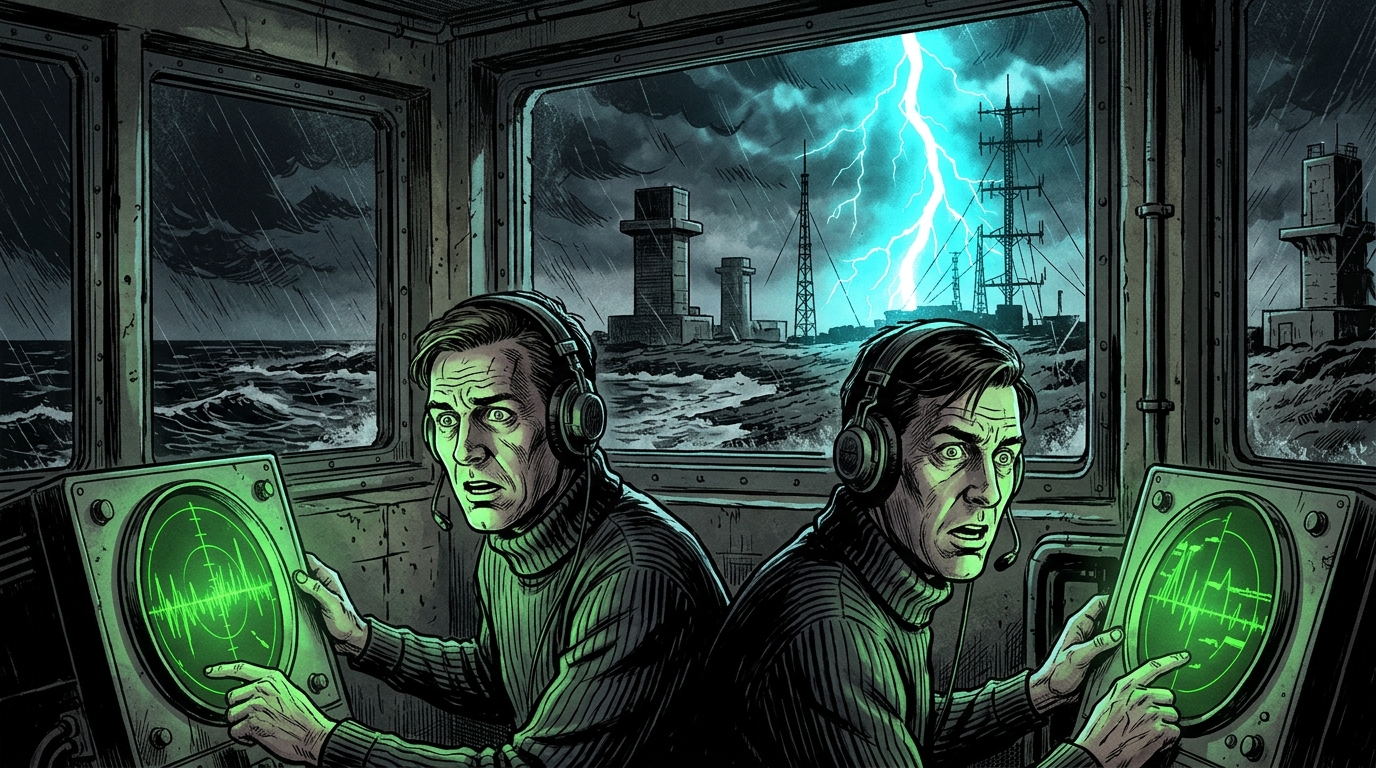
The Asteroid Belt (4.54 Billion BC) • The Upper Atmosphere • The Arabian Sea & Southern Urals
Before there was London, before the red mud of Calicut had ever known the heel of a fisherman or the keel of an empire, there was only the cold, unyielding silence of the belt.
Four and a half billion years ago, when the newborn solar system was a churning disc of incandescent dust, spacetime had shuddered through its primordial cooling. In that violent phase transition, as the geometry of creation froze into order, a microscopic defect became trapped. It was a knot of zero-entropy curvature—a point where the thermodynamic arrow never caught, where time never learned which direction to march. Swallowed whole into the molten nickel-iron core of a protoplanetoid between Mars and Jupiter, the anomaly slept for aeons in the frozen pitch.
Then came the grain of sand.
A gravitational resonance from Jupiter’s immense flank—a silent Kirkwood-gap perturbation no heavier than a whisper—deflected two tumbling boulders into a grazing impact at five miles per second. The collision did not pulverise the iron body; it sheared it along an ancient, crystalline fault line. The protective mantle stripped away, exposing the translucent core to unfiltered solar radiation. Over a hundred thousand years, the asymmetrical pressure of solar photons—the Yarkovsky drift—slowly bled the boulder’s orbital momentum millimetre by millimetre, until its orbit tipped into the sun’s gravitational well.
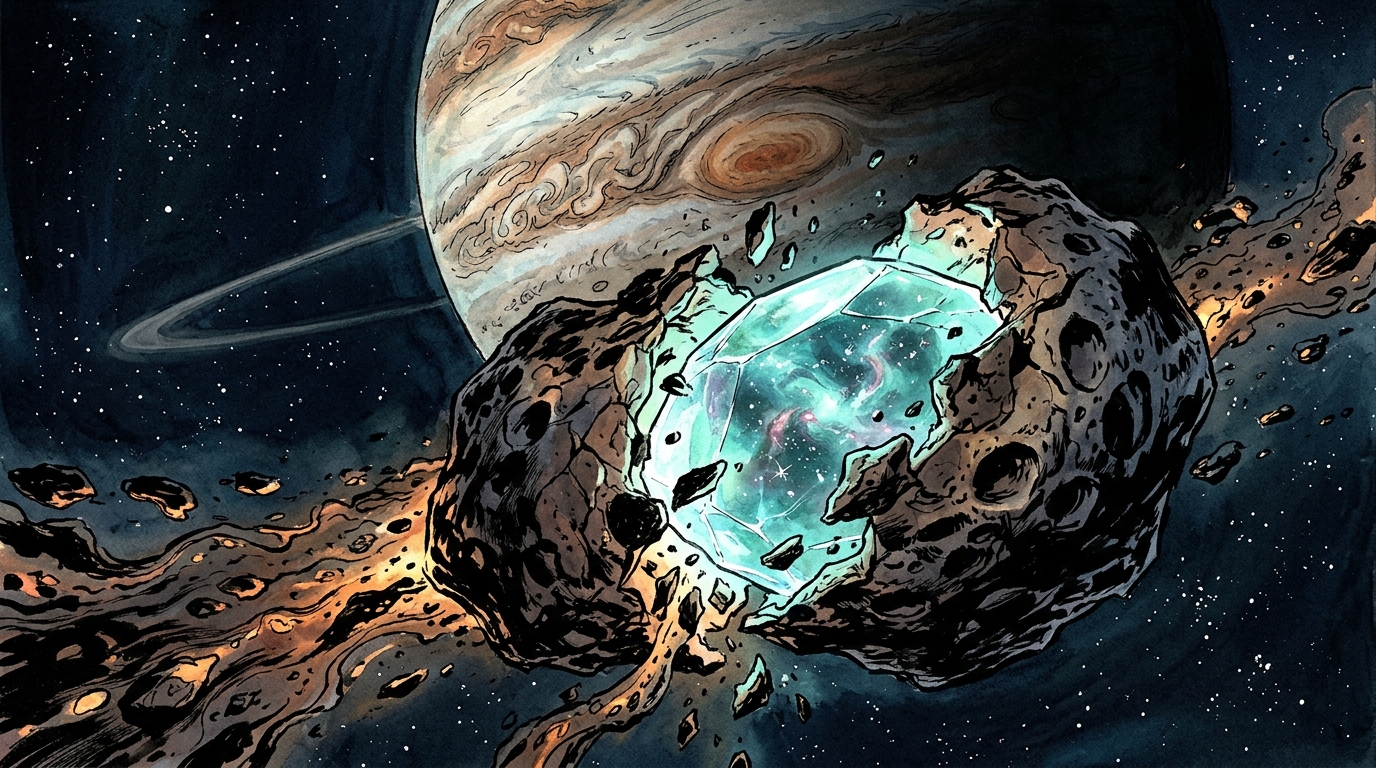 4.54 Billion BC — A Kirkwood-gap collision strips the protoplanetoid mantle in the Asteroid Belt, exposing the zero-entropy crystalline core
It struck the earth’s mesosphere at forty-five thousand miles per hour.
The friction of atmospheric entry did not merely melt iron; it excited the dormant metric anomaly within. As the bolide screamed across the stratosphere, the compression wave tore the stone in two. The first fragment—Fragment Alpha—arced southwards, detonating in a blinding flash over the Arabian Sea and plunging into the shallow limestone waters of the Malabar coast, waiting for an eagle, a Portuguese clerk, and a fisherman’s boy. The second fragment—Fragment Beta—sheared north-eastwards across the Eurasian landmass, burying itself deep in the frozen taiga and ancient granite veins of the Southern Urals.
Severed by continents and millennia, the two stones were never separated. They remained an entangled quantum pair—two halves of a single cosmic coin held in superposition. For four billion years, while Alpha was chipped, set into English gold, and forced to turn the escapement of John Harrison’s chronometers, Beta lay silent in the Russian permafrost, holding the counterweight.
A pendulum can swing only so far before the ratchet must let go.